
aangan

last week, i went swimming again after a gap so long it had dissolved into the kind of forgetting where days smear like wet ink and nights fray like restless dreams starved of sleep. the pool was feverishly warm, as though the sun had pressed its lips against the surface all afternoon, leaving it glowing, a lukewarm shimmer draped like a blanket folding around my ribs. each time i sank my head beneath, my body rehearsed its old script of fear: lungs collapsing inward, hair strung with chlorinated ornaments, panic thrumming in my chest like fists against locked doors. it happens unfailingly, so ritualistically, that my body has learned to cradle the strangeness, almost as if it alchemizes drowning into catharsis.
but that day, something shifted. the water did not drag. it carried. it held. it swaddled. it curved around me as though i were a fetus drifting in the velvet amniotic dark of a womb. maybe it was the heat that was liberating, maybe it was the ache of homecoming, of relief, of summer, those vanished summers when may to july melted into endless afternoons at my nani’s house.
my ma used to tell me how every room in nani’s home had a name, tivara because it had three doors, aari because it was wider than taller, bungli because it was the largest room giving the impression of a bungalow, each room whispering secrets, carrying memories shared across generations. for as long as i can remember, the place always held more people than its walls could bear, yet it stretched, moulded, shape shifted to make space for everyone.
the two-storey building was stitched together by a narrow stone staircase, its steps rough and uneven, too high to be jumped, too steep to be crawled, plaster chipped in patches, the walls on either side enclosing it like a secret passage. tiny carved alcoves were set into those walls, where my nani, unfailingly, would light diyas each evening, even when her knees, bruised with age, trembled too much to climb with ease.
every summer, she would line the floor of her room with thick mattresses and drag out the giant cooler. we kids would spend hours singing into its mouth, our voices cracking, breaking, distorted into shrieks that left us rolling in laughter. and still, in the middle of the night, she would rise to refill its water tank, as if her body had been designed only to love, only to care. she had viridity in her eyes, poems flowing in her veins, lost vocabularies in her mouth, celestial secrets in her palms, and an entire home in her heart.
it’s strange how, when i think of her, i don’t just remember her face, but the house itself, as though she had dissolved into its walls and terraces, into every crevice and corner. i remember dried spices spread evenly on her faded sarees across the terrace, turmeric and red blazing like small suns. i remember her back bent, breaking dough into long, fragile strands of seviya, her palms rolling devotion into food, stirring it into kheer with a pinch of kesar until the room itself smelled like tenderness.
i remember the blue soap in her bathroom, shaped like a brick, a soap that never seemed to end, bleeding your hands dry, staining blue everything it touched, stubborn like her love. i remember her sitting by the window peeling mangoes and tamarinds, the air sticky-sweet with their scent, while old songs spilled from the cassette player, “ham tere pyar mein sara alam, kho baithe hai, kho baithe hai.”
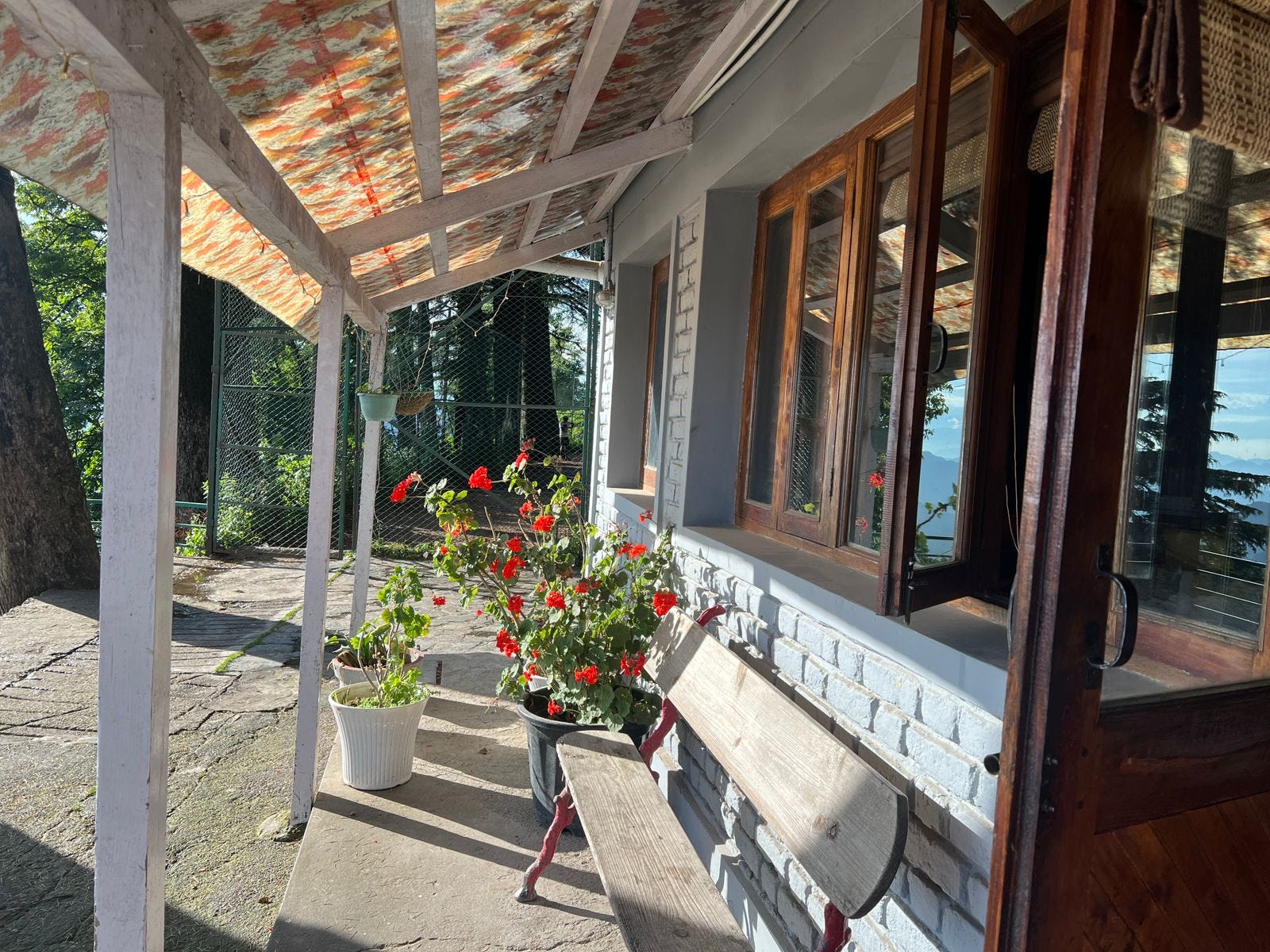
i remember dreamcatchers and yarn birds swaying in the chokhat, a geometry box crammed with hairpins, galaxies dissolving in her morning chai. i remember her always leaving rice for the crows on the terrace, washing dirt off her feet at the handpump in the aangan after chasing monkeys away from the aam papad she left basking in the sun.
i remember her wearing mehendi every week, henna dark and intricate on her palms, the same palms that tucked cotton blankets on the terrace for us to lie beneath the sky, to let us count stars until sleep stole us away. those nights stretched time itself, nights that felt longer than the days, even though we were at the height of the summer solstice.
after swimming, i walked back home, the heat of the day still clinging to my skin, the sun soft and gold as it began its descent. the sky was crisp and spotless like a freshly made bed, its sheet blue and warm and creaseless, tucked into its asymptotic ends. after weeks of unceasing rain, the air smelled like dried flowers and old childhood memories. my cat loves newly made beds as much as she loves basking in sunlight, her white fur glistening in the morning glow, smelling sun-warmed dust and autumn air. she was named after the rain, but she owns the summer, and we sit together on our newly made bed, watching birds own the spotless sky.
and in that stillness, i was reminded of an old story, Eidgah by Premchand, that my ma used to read to me and my sister when we were young. a story of a boy, Hamid, who visits a mela with his friends. there are myriads of charming things in the mela to enthral a child, his friends buy flattering clothes, toy cars, delicate dolls, but Hamid, most surprisingly, buys tongs for his grandma. he returns home, places the tongs in her hands and says, “i bought this for you dadi so that you don’t burn your hand again while cooking.” the story was so heartwarming it would send a tremor through my heart, and once again i terribly missed my grandmother.
R.F. Kuang had said, “the eyesight is largely memory, the brain sees the patterns and fills in the rest.” perhaps that’s true. your brain perceives vision in moments, stitching memories as if they were yarn stretched across timelines, fabricating a non-homogeneous, indistinguishable piece of cloth, which wrings out remembrance until it’s impossible to tell where the pattern ends and the memory begins. i believe grief is just memories revisiting, looping back to the people and places, like a knife in your throat, like cold water in your eyes.
during her last days, my old and frail grandmother lay in bed with no memory of anyone and no sense of touch in her body. ma routinely travelled to look after her, speaking to her even when she could not recognise her, even when no words would come. and yet, every time ma prepared to leave, changed her clothes, combed her hair, packed her suitcase, a tear would slip from my grandmother’s eye, tracing the length of her wizened face. “i miss you more than i could remember you.”
she passed away not long after, and i’ve seen ma carry so much love in her heart with nowhere to put it. she bore the weight of a neutron star, her heart so heavy, so dense, so ready to collapse. and yet i’ve seen her heal. i’ve seen her wear golden bangles belonging to my grandmother, carrying a piece of her in her arms. i’ve seen her make her tea just the way my grandmother liked, and drape the sari my grandmother loved, just to hear someone say, “you look just as beautiful as your mother.”
i’ve seen her tell us the story of when my young grandfather first came to see my grandmother, and how she, shy and flustered, would secretly watch him from the window while her sisters teased her until she flushed and covered her face. even though there isn’t a second when ma doesn’t miss her, i’ve seen her make peace with the tiny shards of memory, with the pieces of my grandmother she hoarded to keep her heavy heart from collapsing into a cosmic explosion.
my nana could not bear the pain of living without her, and he passed merely twenty days after. maybe “to die by your side is such a heavenly way to die.” i remember every night, he would open his kitaab where he jotted down his poems, some about life, others about love. it mesmerised me, because ma always said his love for poetry had passed down to me.
today, the poetry notebook is still there, its empty pages flipping helplessly like the emptiness in our hearts, desperate to be filled with gazals and geets. today, the childhood home is still there, but without its two protagonists, whose voices once felt like warm hugs and a gush of wind in the heat of july. the story of Hamid is still there, the memories are still there, yet a profound grief surrounds them, as if the house itself has been stitched with absence.
ma shared a small poem penned by my nana, a piece she had always adored. -
जाने कितनी सुबह बाक़ी है, जाने कितनी शाम बाक़ी है।
अभी तो उम्र के न जाने कितने पड़ाव बाक़ी है।
लौट जा मात न दे वार वार अपने पैग़ाम मुझे।
अभी तो वतन की माटी न जाने कितने हिसाब बाक़ी है।
ठहर जा शाम ज़रा न देख आसमां की तरफ़।
सूरज के बेटों के अभी न जाने कितने काम बाक़ी हैं।
न कर इन हाथों से उनकी क़लम लेने की साज़िश ही।
न जाने कितने गीत बाक़ी हैं, न जाने कितनी ग़ज़ल बाक़ी है।
अभी तो बदलना है हवाओं के रूख़ मुझको।
बस खुदा तुझको भी करना सलाम बाक़ी है।
My grandparents are at this stage in life now. Tears sprung in my eyes as I read this. How do I carry all this love that I have for you? 💗 Where do I keep it? What about the love you have for me? Where will it go?
absolutely beautiful